Plant ID Guide: Stop Confusing Look-Alikes
Side-by-side comparison of commonly confused plants: roses vs. China roses, peppermint vs. spearmint, Haworthia cooperi vs. other window succulents, and creeping jenny vs. pennywort—from key traits and ID tips to care differences.
Introduction: Why Do We Misidentify Plants?
In the plant world, look-alikes are everywhere. Closely related species, cultivated varieties, and regional names make identification a skill that demands careful observation. Beginners often buy a "rose" only to find, months later, that it is a China rose; or assume they are growing spearmint for tea when it is ordinary peppermint. Misidentification not only affects how we care for plants but can lead to wrong light, water, and soil—and in some cases, poor growth or loss.
Getting the ID right matters far beyond naming. Similar-looking plants can belong to different families or genera and have very different needs—some sun-loving and drought-tolerant, others shade-loving and moisture-dependent; some need a cold period to bloom, others flower year-round in warmth. Correct identification also reveals ornamental, medicinal, or edible uses and avoids misuse. Lastly, it is the basis for learning proper care: only when we know what we are growing can we provide suitable conditions.
This guide compares several pairs of easily confused plants—from key features and practical ID tips to differences in care—so you can tell them apart with confidence.
I. Roses vs. China Roses: A Name Mix-Up
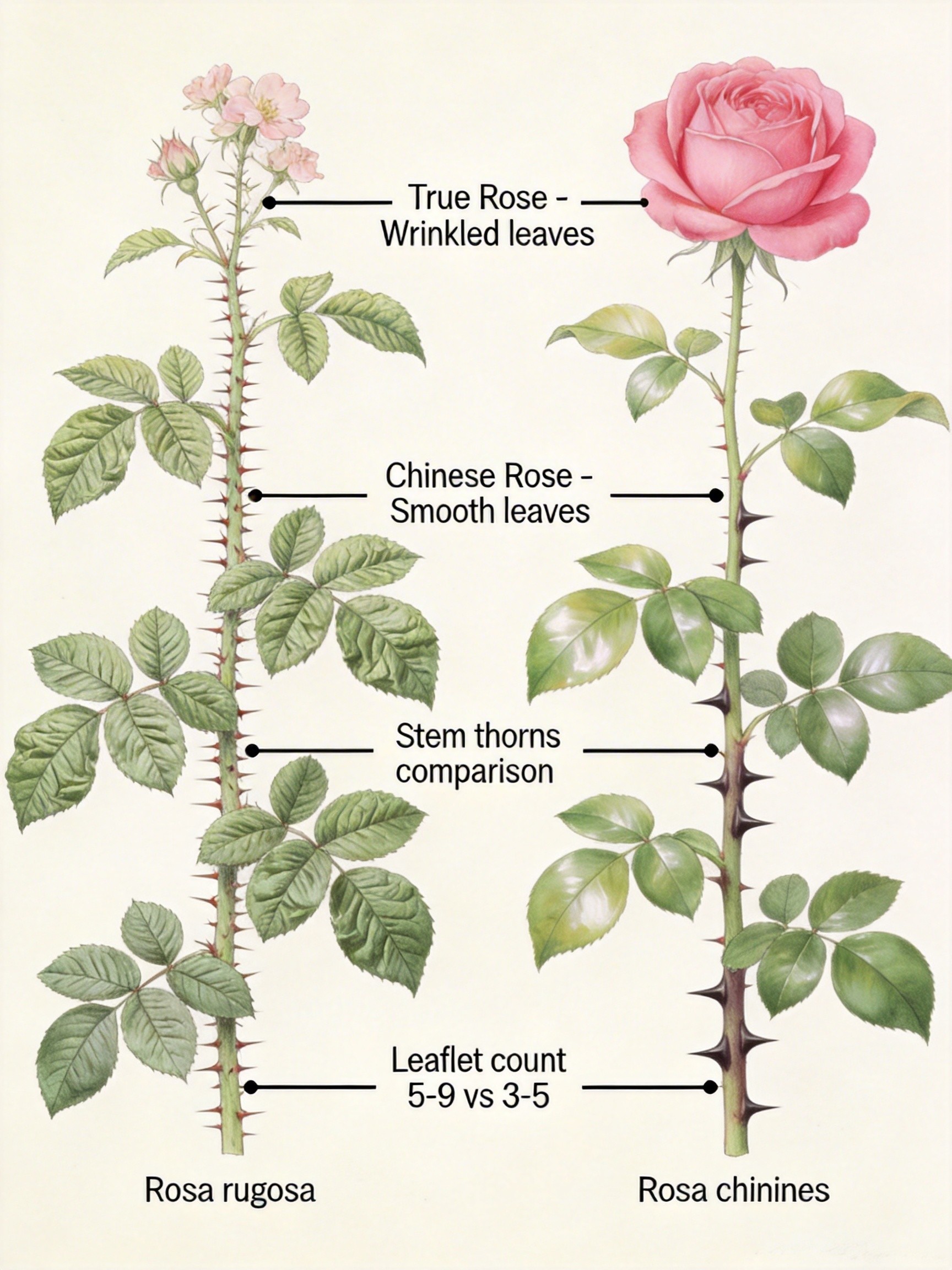
1.1 Key Differences
| Trait | Rose | China rose |
|---|---|---|
| Leaves | Prominent sunken veins, 5–9 leaflets, slightly wrinkled surface | 3–5 smoother, glossier leaflets |
| Stems | Dense, fine prickles and bristles | Larger, fewer thorns; some cultivars nearly thornless |
| Flowers | Single or in small clusters, thick petals, smaller blooms | Larger, often double, in many colors |
| Bloom | One or two flushes per year | Repeat or continuous bloom (hence "monthly" rose) |
| Scent | Strong, lasting fragrance | Variable; some cultivars have little or no scent |
1.2 Practical ID Tips
Tip 1: Feel the leaves. Run your finger along the underside. Roses have a distinct bumpy texture, thicker leaves, and fine hairs; China rose leaves feel smoother and flatter.
Tip 2: Check the thorns. Rose stems are covered in fine, dense prickles; China roses usually have fewer, larger thorns, and some varieties are almost thornless.
Tip 3: Count the leaflets. On compound leaves, roses typically have 5–9 leaflets; China roses often have 3–5. This needs a close look but is a reliable clue.
1.3 Care Differences
Light: Both like full sun. Roses tend to be hardier in cold (e.g. down to about -15°C); China roses can bloom year-round in mild climates but need winter protection where it freezes. Water: Roses dislike wet feet—use well-draining soil and water when the top layer is dry; China roses need more water in the growing season but still avoid waterlogging. Pruning: For roses, focus on removing old or weak wood in winter; China roses benefit from deadheading and more frequent shaping to encourage repeat bloom. Feeding: Roses like moderate feeding (e.g. organic in spring and autumn); China roses are heavier bloomers and often do well with a dilute liquid feed every two weeks in the growing season.
II. Peppermint vs. Spearmint: Same Family, Different Genus
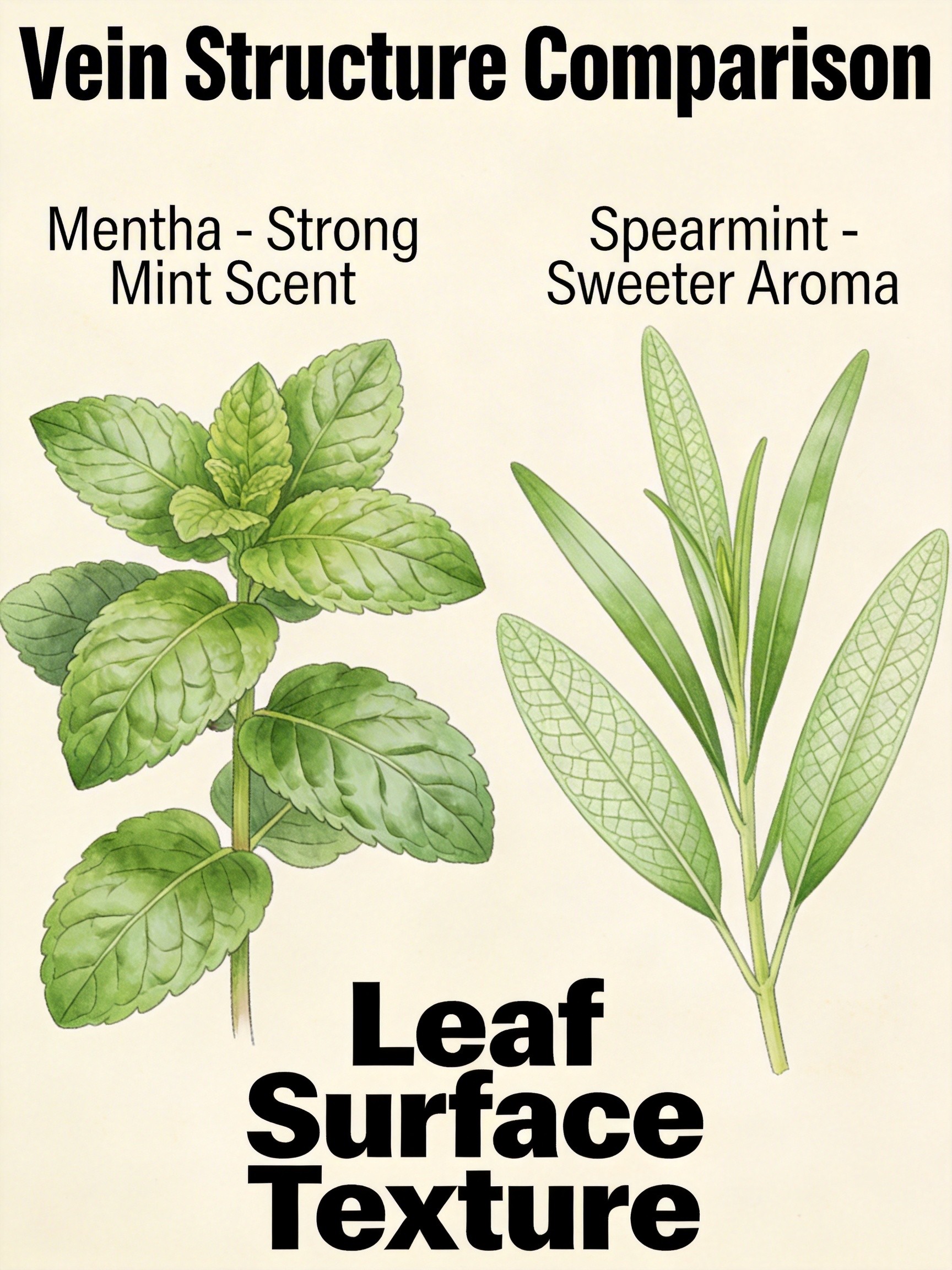
2.1 Key Differences
| Trait | Peppermint | Spearmint |
|---|---|---|
| Family / genus | Lamiaceae, Mentha | Lamiaceae, Mentha spicata group |
| Leaf shape | Ovate to oblong, pointed tip | Ovate-lanceolate, slender tip |
| Veins | Clear midrib and side veins | Finely reticulate |
| Scent | Strong cooling, distinct menthol | Softer, sweeter, less sharp |
| Habit | More spreading, can be creeping | More upright, branched |
| Spread | Aggressive rhizomes | Spreads mainly by cuttings and division |
2.2 Practical ID Tips
Tip 1: Crush a leaf and smell. Peppermint gives a strong, sharp coolness; spearmint is milder and slightly sweet.
Tip 2: Look at the flower spikes. Peppermint has denser, more compact spikes; spearmint spikes are looser and the flowers a bit smaller. Easiest to compare when in bloom.
Tip 3: Watch how they grow. Peppermint spreads vigorously by rhizomes and can become invasive; spearmint is usually more upright and less aggressive.
2.3 Care Differences
Light: Both prefer sun; spearmint tolerates a bit more shade. Water: Peppermint likes moisture but not waterlogging; spearmint is slightly more drought-tolerant. Containment: Peppermint needs barriers or pots to limit spread; spearmint is easier to contain. Harvest: Both can be harvested for leaves; avoid over-pruning spearmint if you want flowers. Winter: Peppermint dies back above ground; spearmint may stay green in mild areas and needs protection in cold ones.
III. Haworthia Cooperi vs. Other Window Haworthias: Succulent Look-Alikes
3.1 Key Differences
| Trait | Cooperi-type (jade dew) | Other window types |
|---|---|---|
| Leaf window | Large, very clear, glass-like | Narrower, with visible "window" lines |
| Leaf shape | Short, plump, tightly packed | Longer, triangular "window" at tip |
| Habit | Low, compact rosette | Taller, looser rosette |
| Markings | Fine or faint on window | Clear lines or dots on window |
| Transparency | Very high | Lower, often semi-opaque |
3.2 Practical ID Tips
Tip 1: Check window transparency. Cooperi-type leaves are very clear when backlit; the other type is often semi-transparent or opaque.
Tip 2: Look at leaf shape. Cooperi-type: short, chubby, blunt tip; the other: longer leaves with a distinct triangular "window" at the tip.
Tip 3: Look at markings. Cooperi-type has fine or subtle lines; the other has clearer longitudinal or dotted patterns.
3.3 Care Differences
Light: Both need protection from strong sun; cooperi-type is more prone to bleaching. Water: Cooperi-type is very drought-tolerant; the other needs a bit more water but still sparingly. Airflow: Both need good ventilation; cooperi-type is more at risk of rot in heat. Propagation: Both can be divided or leaf-propagated; cooperi-type has lower leaf success, so division is more reliable. Soil: Cooperi-type often does well with more grit (e.g. 70%+); the other with slightly less (around 50–60% mineral).
IV. Creeping Jenny vs. Pennywort: Names That Sound Alike
4.1 Key Differences
| Trait | Creeping jenny | Pennywort |
|---|---|---|
| Scientific name | Lysimachia christinae | Hydrocotyle vulgaris |
| Family | Primulaceae, Lysimachia | Apiaceae, Hydrocotyle |
| Leaf size | Small, about 1–2 cm across | Larger, about 2–5 cm across |
| Leaf edge | Smooth, entire | Slightly toothed |
| Habit | Creeping, roots at nodes | More upright, suitable for water or soil |
| Flowers | Small yellow flowers in summer | Small white flowers, less common |
| Use | Often medicinal (e.g. traditional use) | Often ornamental, aquatic or terrestrial |
4.2 Practical ID Tips
Tip 1: Leaf size. Creeping jenny leaves are usually under 2 cm across; pennywort is larger, often 3–5 cm, so the difference is obvious.
Tip 2: Feel the leaf edge. Creeping jenny is smooth; pennywort has a slightly toothed, rougher edge.
Tip 3: Growth form. Creeping jenny runs along the ground and roots at nodes; pennywort is more upright and is commonly grown in water or soil.
4.3 Care Differences
Water: Creeping jenny likes moisture but needs good drainage; pennywort likes wet conditions and can be grown in water with regular changes. Light: Creeping jenny prefers part shade; pennywort likes bright indirect light. Temperature: Creeping jenny is hardier; pennywort is sensitive to cold and is often kept above 5°C in winter. Feeding: Creeping jenny has modest needs; pennywort grows fast and benefits from regular feeding, including in hydroponic setups. Propagation: Creeping jenny by division or runners; pennywort propagates easily by division or stem cuttings.
V. Summary and Recommendations
Plant ID relies on observation and patience. From the pairs above, a few principles stand out: (1) Use several traits—leaf, flower, stem, scent—rather than one. (2) Consider season: some plants are easier to tell apart in bloom. (3) Note growth habit and spread. (4) Use apps or field guides when you are unsure; image-based tools can speed up identification.
In practice, correct identification is the first and most important step. Only when we know what we are growing can we provide suitable light, water, fertilizer, and temperature and avoid poor growth or loss.
Get into the habit of "identify first, then care": when in doubt, confirm the species with an app or guide, look up care for that species, then plan accordingly. That reduces mistakes and builds your plant knowledge over time.
The value of a plant lies not in its name but in understanding and caring for it well. With a bit of practice, you can confidently tell these look-alikes apart and give each plant the conditions it needs to thrive.
You may also like
More plant care and identification knowledge